Quick Answer: Trying to figure out “what is this owl?” Start with four field marks: size, ear tufts (present or absent), eye color, and facial disc shape. North America has about 19 regular owl species, but most backyard or roadside sightings come down to a handful of candidates. This guide walks you through each one.
What Is This Owl? Four Field Marks to Check First
Before you reach for a field guide, run through this mental checklist:
- Size — Was it crow-sized, cat-sized, or bigger?
- Ear tufts — Did it have feather “horns” on its head?
- Eye color — Yellow, orange, or dark brown?
- Facial disc — Round, heart-shaped, or heavily outlined?
Those four questions alone will eliminate most species. Everything else — plumage pattern, call, habitat — confirms what you’ve already narrowed down.
Most Commonly Encountered Owls at a Glance
| Species | Clincher Field Mark |
|---|---|
| Great Horned Owl | Wide-set ear tufts + white throat bib |
| Barred Owl | Dark brown eyes, no tufts, barred chest |
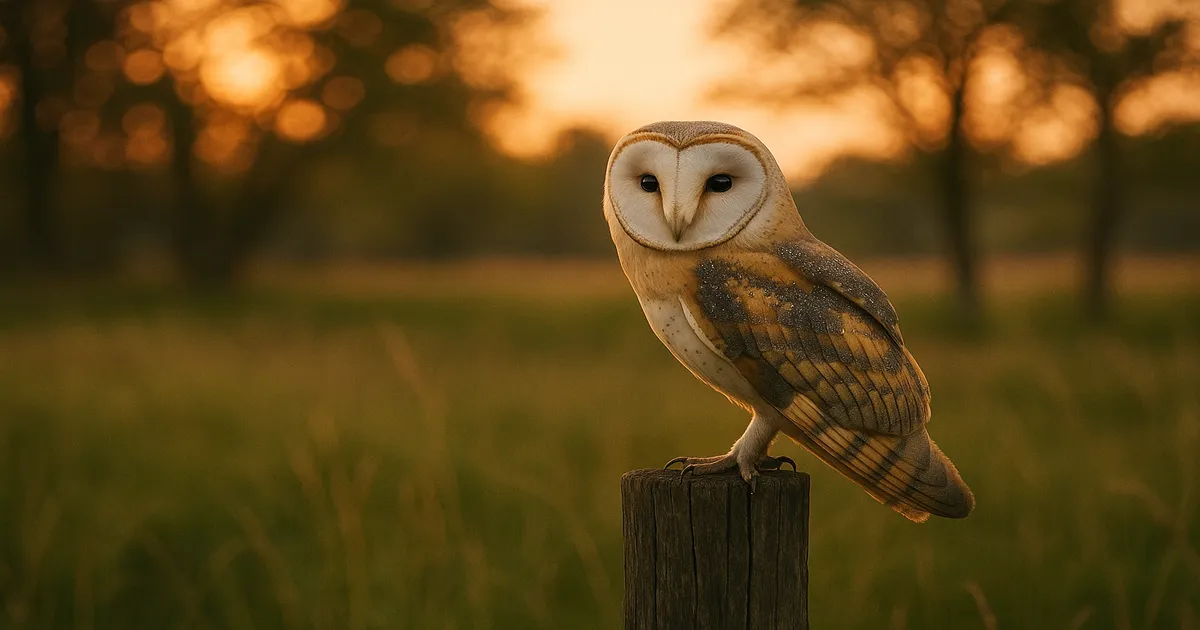
| Barn Owl | Heart-shaped white facial disc |
| Eastern Screech-Owl | Small, streaky, rufous or gray morph |
| Western Screech-Owl | Like Eastern but dark (blackish) bill |
| Burrowing Owl | Long legs, stands on ground |
| Northern Saw-whet Owl | Tiny, round-headed, reddish-brown streaks below |
| Snowy Owl | White plumage, round head, yellow eyes |
| Short-eared Owl | Black wrist patches in flight, moth-like wingbeat |
| Long-eared Owl | Tall, close-set ear tufts, slender build |
Key Field Marks: What to Look for on Any Owl
Size and Body Shape
Start with size — it’s the quickest filter. A Great Horned Owl (Bubo virginianus) is roughly cat-sized, while a Northern Saw-whet Owl (Aegolius acadicus) fits in your cupped hands. Comparing an unknown owl to a nearby crow, fence post, or tree branch gives you an instant size reference even in poor light.
Ear Tufts: Present or Absent?
Ear tufts trip up a lot of new birders. They are not ears — they’re feather clusters used for communication and camouflage. The actual ears are asymmetrical openings hidden under the facial feathers, which is how owls pinpoint prey in total darkness.
Tufts can be laid flat, making a tufted owl look round-headed, so don’t rule them out just because you didn’t see them. That said, a truly smooth, round head almost always means no tufts — think Barred Owl (Strix varia), Barn Owl (Tyto alba), or Saw-whet.
Eye Color and Facial Disc
Yellow eyes are the default for most North American owls. Dark brown eyes narrow your list fast — mainly Barred Owl and Barn Owl among common species. The Barn Owl’s small, dark eyes combined with that heart-shaped white disc are unlike anything else you’ll encounter.
The facial disc acts like a satellite dish, funneling sound toward the ears. Its shape — round, heart-shaped, or tightly outlined — is one of the most reliable ID features at any distance.
Plumage Patterns: Barring, Streaking, and Spots
These terms matter. Barring runs horizontally across the breast (like a ladder). Streaking runs vertically (like drips of paint). The Barred Owl has a barred chest but a streaked belly — that combination is a genuine ID clincher. Great Horned Owls are barred throughout the underparts. Saw-whet Owls are streaked below with a white-spotted brown back.
Leg Length and Posture
Most owls look compact and short-legged. The Burrowing Owl (Athene cunicularia) is the exception — built long-legged by design, it stands upright on the ground like a tiny sentinel. If you saw a small owl on a fence post or bare earth in open country, Burrowing Owl should be your first thought.
Identifying the 10 Most Common North American Owls
Great Horned Owl
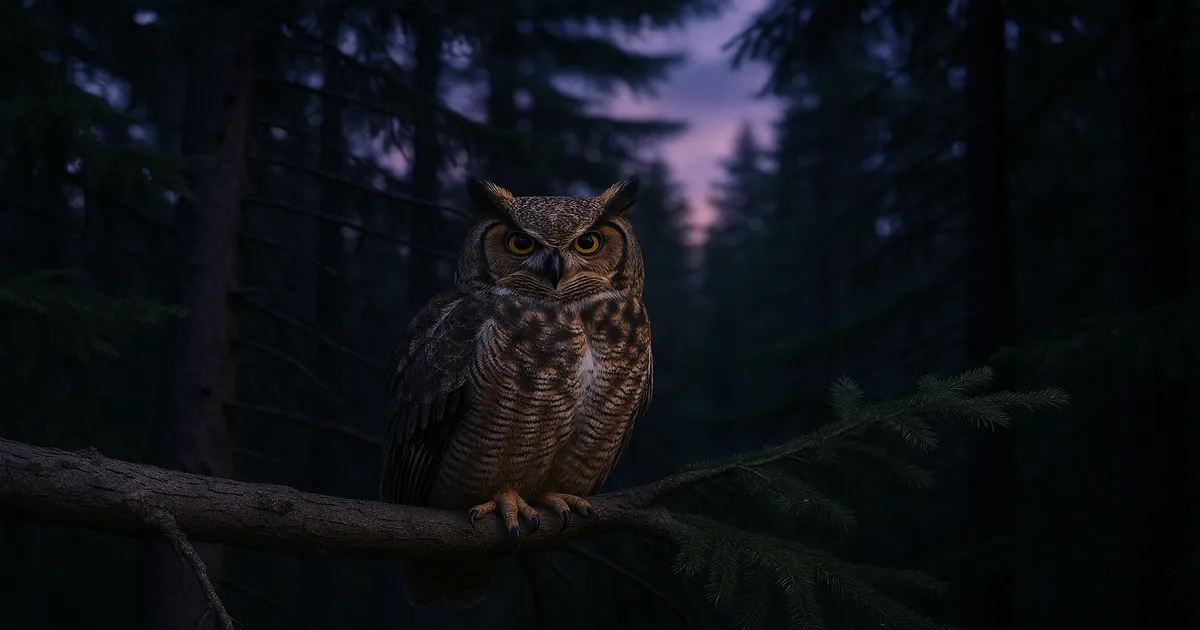
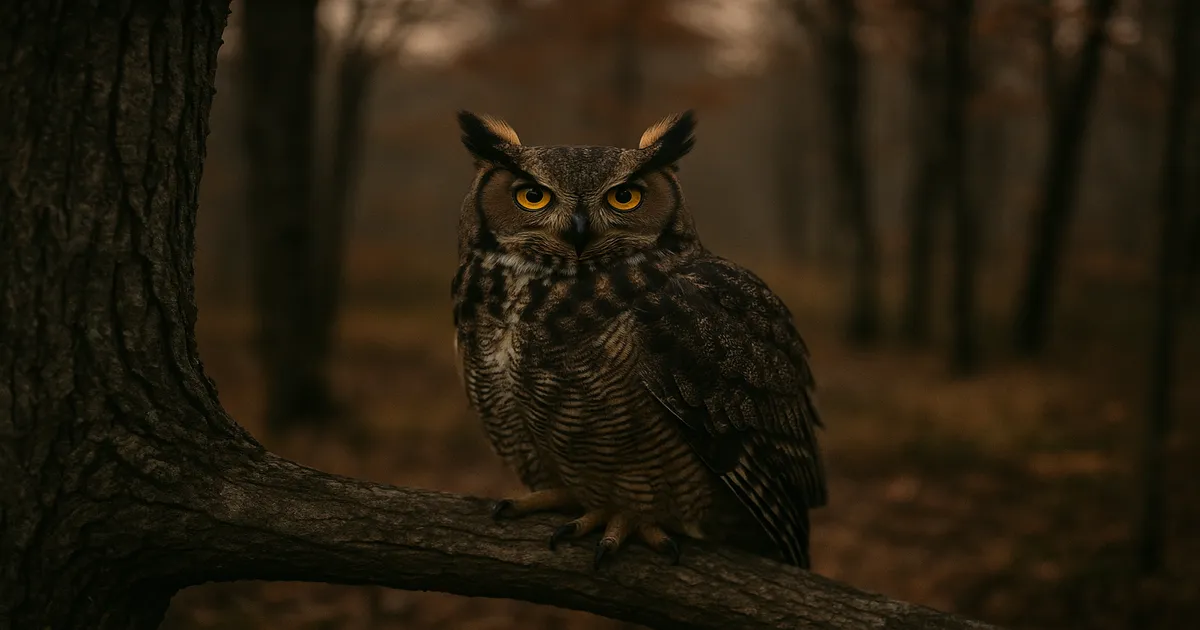
About 18–25 inches (46–64 cm) long with a wingspan up to 57 inches (145 cm), this is the owl most people picture. Wide-set ear tufts and a bright white throat bib are the clincher — no other large common owl has both. Plumage is rich brown and buff, heavily barred below, with large yellow eyes set in a reddish-brown facial disc.
Females are noticeably larger than males, though both sexes look identical in plumage. The most likely confusion species is the Long-eared Owl, but that bird is much slimmer with tufts set close together near the center of the head.
Barred Owl
At 16–25 inches (40–63 cm), the Barred Owl overlaps in size with the Great Horned but looks completely different up close. Dark brown eyes on a large, round, tuft-free head set it apart from virtually every other owl its size. The barred chest transitioning to a streaked belly is unique among common species. You’ll hear this bird long before you see it — its “Who cooks for you? Who cooks for you-all?” call is one of the most recognizable sounds in eastern forests.
Barn Owl
About 12.6–15.8 inches (32–40 cm) long, the Barn Owl (Tyto alba) is unlike anything else in North American skies. That heart-shaped white facial disc is unmistakable, even in car headlights. Tawny-golden upperparts contrast sharply with pale, lightly spotted underparts. Males tend to be whiter below; females are more spotted. Barn Owls don’t hoot — they produce a raspy, drawn-out screech that’s genuinely unsettling the first time you hear it at midnight.
Eastern Screech-Owl
At 6.3–9.8 inches (16–25 cm), the Eastern Screech-Owl (Megascops asio) is small, stocky, and extraordinarily well-camouflaged. It comes in two color morphs — rufous (reddish-brown) and gray — and both are so bark-like that you can walk past a roosting bird without a second glance. Small ear tufts are often held flat. Yellow eyes and a pale greenish-gray bill help at close range. The gray morph dominates in the North; rufous is more common in the South.
These birds take readily to nest boxes mounted on mature trees in suburban yards — if you want to attract one, a wooden screech-owl box is worth putting up in fall.
Western Screech-Owl
Nearly identical to the Eastern in size and shape — genuinely one of the tougher visual IDs in North American birding. The best single field mark is bill color: the Western’s bill is dark (blackish), while the Eastern’s is pale greenish-gray. The Western is also generally grayer overall, with the rufous morph being rare in the West. Where ranges don’t overlap, geography solves the problem. Where they meet in the Great Plains, bill color and call are your best tools.
Burrowing Owl
Those conspicuous long legs make the Burrowing Owl instantly recognizable — no other small owl stands upright on the ground in open country. About 7.5–9.8 inches (19–25 cm) long, with a round head, no ear tufts, bright yellow eyes, and brown-and-white spotted plumage. A white supercilium gives it a wide-eyed, expressive look. Juveniles have a plain buff breast band instead of the adult’s barring. Young birds in their burrows can produce a convincing rattlesnake-like buzzing to deter predators — a remarkable trick for a bird this small.
Northern Saw-whet Owl
One of the smallest owls in North America at 7–8.5 inches (18–21 cm). The oversized round head, white facial disc with a dark border, and rich reddish-brown streaking on white underparts are the key features. First-year birds look dramatically different from adults: rich tawny-cinnamon below with a white triangular forehead patch. If you see a tiny owl that doesn’t match adult Saw-whet descriptions, check whether it’s a juvenile — it’s a common point of confusion.
Snowy Owl
There’s no other owl you’re going to confuse a Snowy Owl (Bubo scandiacus) with. At 20.7–27.9 inches (52–71 cm) with a wingspan up to 57 inches (145 cm), it’s a large, round-headed, white owl with yellow eyes and no ear tufts. Adult males can be nearly pure white; females and immatures carry heavier brown barring and can look quite dark overall. In irruption years — when Arctic lemming populations crash — Snowy Owls push south in numbers, appearing at airports, lakeshores, and open fields well into the lower 48. They tend to sit in plain sight on fence posts or rooftops, not particularly bothered by people.
Short-eared Owl
Medium-sized at 13.4–16.9 inches (34–43 cm) and one of the few owls you’re likely to see in full daylight. In flight, the black wrist patches on pale underwings are diagnostic — look for them as the bird quarters low over a field with a buoyant, moth-like wingbeat. On a perched bird, yellow eyes surrounded by dark smudgy patches give it a striking “mascara” effect. The tiny ear tufts are rarely visible in the field. Females are darker and more heavily streaked than males.
Long-eared Owl
Often overlooked because it roosts silently in dense conifers, the Long-eared Owl (Asio otus) is worth knowing well. At 13.8–15.8 inches (35–40 cm), it’s medium-sized but appears tall and slender. Long ear tufts set close together near the center of the head distinguish it from the Great Horned Owl, whose tufts are wide-set. The orange-buff facial disc with a white X-pattern between the eyes is distinctive. In winter, Long-eared Owls sometimes roost communally in groups of a dozen or more — a remarkable sight. Look for whitewash and pellets under likely roost trees.
Identify Owls by Sound
Owls That Hoot
The Great Horned Owl’s classic call — hoo-h’HOO-hoo-hoo — is what most people imagine when they think “owl sound.” A useful mnemonic: “Who’s awake? Me too.” Males have a deeper voice; females pitch slightly higher. Great Horned Owls begin calling in January during courtship, so a hooting owl in the dead of winter is often this species. Long-eared Owls give soft, low hoots that carry surprisingly far in still air.
Owls That Screech, Whinny, or Toot
Here’s a misconception worth correcting: Screech-Owls don’t screech. The Eastern Screech-Owl’s primary call is a mournful, descending whinny — more horse than horror movie. It also gives a long, quavering single-pitch tremolo. The Western Screech-Owl’s signature is a series of short whistles accelerating into a trill, like a bouncing ball slowing to a stop.
The Barn Owl is the actual screecher — a long, harsh, raspy hiss. The Northern Saw-whet Owl gives a repetitive, mechanical single-note toot (too-too-too-too) that can continue for hours. The Barred Owl’s “Who cooks for you? Who cooks for you-all?” sometimes escalates into wild cackling duets between mates.
| Species | Call / Mnemonic |
|---|---|
| Great Horned Owl | ”Who’s awake? Me too” |
| Barred Owl | ”Who cooks for you? Who cooks for you-all?” |
| Eastern Screech-Owl | Descending whinny (like a horse) |
| Western Screech-Owl | Bouncing-ball whistle accelerating to trill |
| Northern Saw-whet Owl | Monotonous too-too-too tooting |
| Barn Owl | Long raspy hiss/screech |
Using a Sound ID App
Merlin Bird ID by Cornell Lab is the best free tool for real-time sound identification — open the app, tap “Sound ID,” and it will identify calling owls in seconds, even in total darkness. It handles owls particularly well because their calls are distinctive and carry cleanly. One honest caveat: Merlin can struggle with distant or wind-masked calls. Cross-reference with recordings on AllAboutBirds.org when you’re not sure.
A good pair of binoculars matters too, especially for picking up subtle field marks on a perched owl at dusk. (Nikon Monarch M5 8x42)
Where and When to Find Owls
Forest Owls
The Great Horned Owl is the least picky raptor in North America — forests, deserts, suburbs, farmland, from the Arctic tree line to Central America. If you hear hooting anywhere on the continent, this is statistically the most likely culprit.
The Barred Owl is a bird of mature eastern forests, especially near water. It has been expanding aggressively westward through Canada into the Pacific Northwest, where it now competes directly with the federally threatened Northern Spotted Owl (Strix occidentalis caurina) — one of the more significant conservation stories in North American ornithology right now.
Long-eared Owls are secretive year-round but become findable in winter when they roost communally in dense conifers. Check recent eBird reports for your area — that’s the fastest way to locate a winter roost.
Open Country Owls
Short-eared Owls hunt grasslands, marshes, and agricultural fields, often in late afternoon. Barn Owls favor open farmland with old barns, silos, or nest boxes — they’re declining in the Northeast and Midwest, so a sighting there is worth reporting to eBird. Burrowing Owls are diurnal and ground-dwelling; look for them on prairies, golf courses, airports, and open flats in the West and Florida.
Small Owls of Woodlands and Suburbs
Eastern and Western Screech-Owls are among the most suburban-tolerant owls in North America. Mature trees, nest boxes, and a reliable food supply of mice and large insects are all they need. Northern Saw-whet Owls breed in northern and montane forests but migrate broadly in fall, turning up in suburban woodlots and even city parks. October through November is the best window to find them away from their breeding range.
A quality field guide is worth keeping in the car for moments like these. (Sibley’s Birds of North America)
Irruptive Visitors: Snowy Owl
Snowy Owls are Arctic breeders that move south in winter, but how far south depends entirely on the year. In strong irruption years, they push well into the lower 48, sometimes appearing at coastal airports and Great Lakes shorelines in surprising numbers. In quiet years, most stay in Canada. eBird’s real-time species maps are far more useful than static field guide maps for tracking where they’ve been reported this season.
Owl Behavior: Extra Clues for Identification
Which Owls Are Active During the Day?
Most owls are nocturnal, but Short-eared and Burrowing Owls hunt regularly in daylight. Short-eared Owls are especially likely in late afternoon over open fields. Barred Owls call during the day more often than most people expect, particularly on overcast mornings. If you spot an owl hunting in broad daylight over a meadow or marsh, Short-eared is your top candidate across most of North America.
Flight Style
Flight style is underused as an ID tool. The Short-eared Owl’s buoyant, erratic wingbeat is unlike any other owl. The Barn Owl flies with slow, deep wingbeats and a tendency to hover briefly before dropping. Great Horned Owls fly with stiff, powerful wingbeats and rarely hover. These patterns are worth learning — they can clinch an ID when the bird is too distant for plumage details.
What Is This Owl? — Frequently Asked Questions
Q: I heard an owl but didn’t see it. How do I identify it by sound alone? Open Merlin Bird ID, tap “Sound ID,” and hold your phone toward the sound. It identifies owl calls in real time and logs the result. For a second opinion, AllAboutBirds.org has recordings for every North American species.
Q: I saw a small owl sitting on a fence post in the daytime. What is it? In the West or Florida, Burrowing Owl is the most likely answer — it’s the only small owl that routinely perches on the ground or low posts in open country during daylight. In the East, a small owl active by day is unusual; a Short-eared Owl is possible in open fields, but Eastern Screech-Owls occasionally sunbathe at cavity entrances.
Q: Is the owl I saw rare or common? Great Horned, Barred, and Eastern Screech-Owls are the three most commonly encountered owls across eastern North America. In the West, add Western Screech-Owl and Barn Owl. A Snowy Owl or Long-eared Owl is always worth reporting to eBird — both are genuinely uncommon in most areas.
Q: Can I attract owls to my yard? Yes, with the right setup. Eastern and Western Screech-Owls will use nest boxes placed on mature trees 10–15 feet up. Barn Owls will use larger boxes mounted on barns or poles in open farmland. Keeping a brush pile and avoiding rodenticide use in your yard helps too — owls need live prey, and poisoned rodents kill raptors.
Q: What’s the difference between a Great Horned Owl and a Long-eared Owl? Size and tuft placement. The Great Horned is noticeably larger (cat-sized vs. slender crow-sized) with ear tufts set wide apart at the outer edges of the head. The Long-eared’s tufts sit close together near the center of the head, giving it a tall, narrow look. The Long-eared also has an orange-buff facial disc with a distinctive white X-pattern between the eyes — the Great Horned’s disc is reddish-brown without that marking.