Quick Answer: If you’re asking “what is this hawk?”, you’re probably looking at one of five species: Red-tailed, Cooper’s, Sharp-shinned, Red-shouldered, or Broad-winged Hawk. Start with body shape — broad wings and a short tail mean a buteo; short rounded wings and a long tail mean an accipiter. Then find the one field mark that clinches the ID.
Figuring out what is this hawk doesn’t take years of experience. It takes knowing what to look for first. Most people try to match every detail at once, get overwhelmed, and give up. The better approach is to work in layers — group first, then species.
Quick Answer: Which Hawk Did You See?
The Five Hawks You’re Most Likely to Encounter
The overwhelming majority of hawk sightings in North America come down to just five species:
| Species | Size | Clinching Field Mark |
|---|---|---|
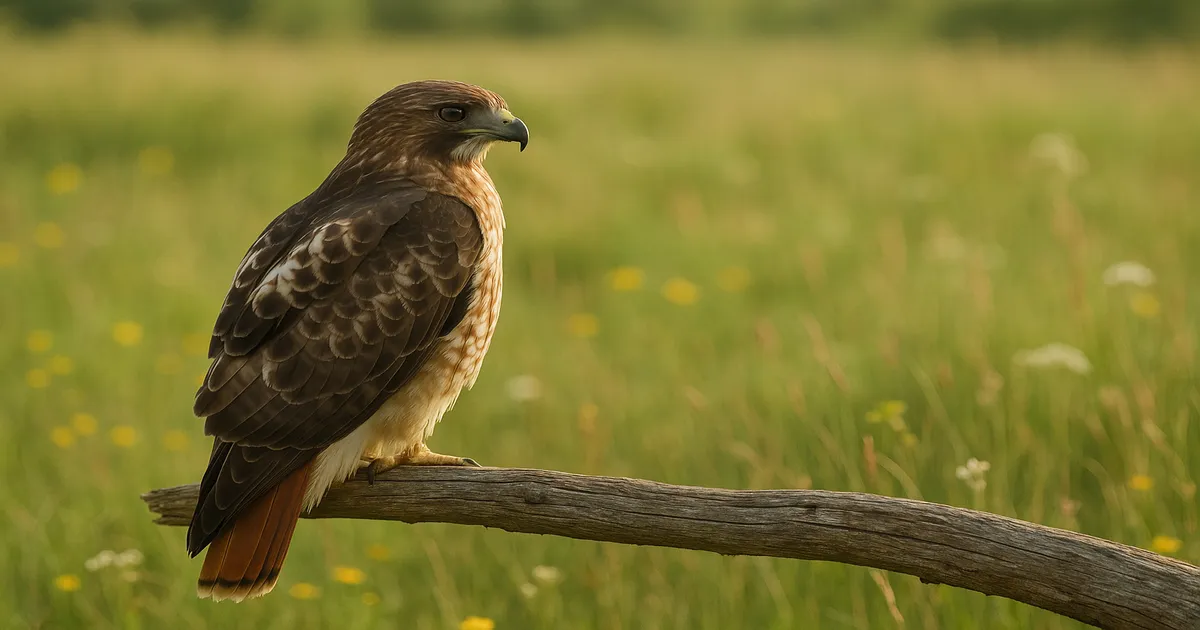
| Red-tailed Hawk (Buteo jamaicensis) | Crow to crow+ | Brick-red tail (adults); dark patagial bars on underwing |
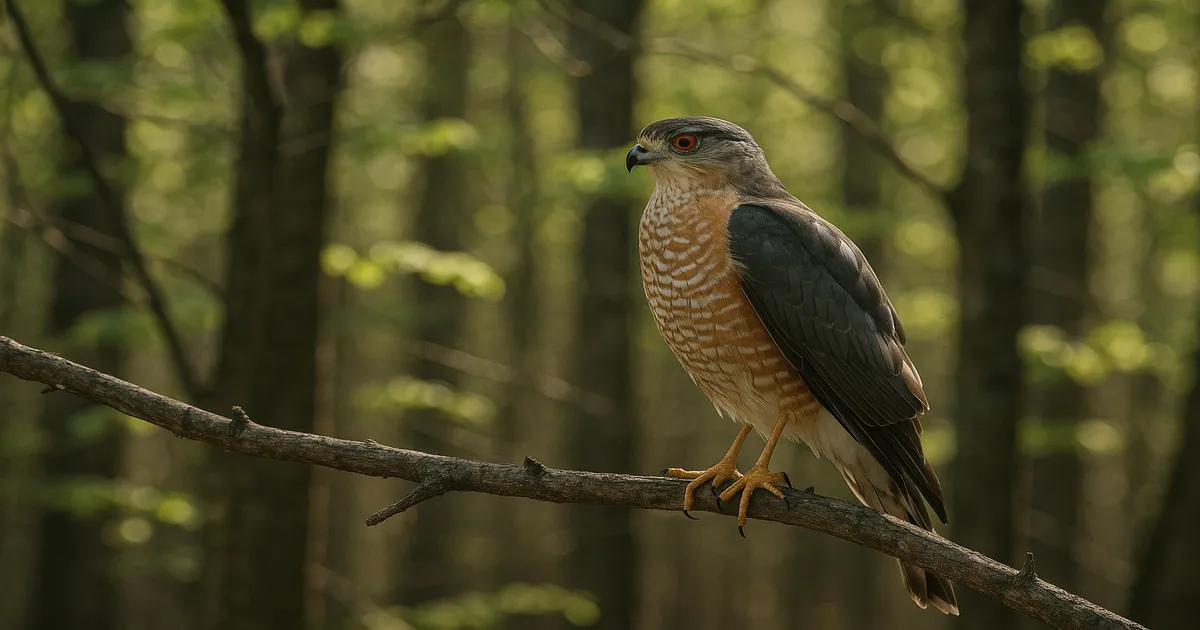
| Cooper’s Hawk (Accipiter cooperii) | Pigeon to crow | Rounded tail tip; pale nape contrasting with dark cap |
| Sharp-shinned Hawk (Accipiter striatus) | Robin to pigeon | Square or notched tail tip; tiny head barely clears wing wrist |
| Red-shouldered Hawk (Buteo lineatus) | Crow-sized | Translucent crescent “windows” near wingtips; bold black-and-white tail bands |
| Broad-winged Hawk (Buteo platypterus) | Pigeon-sized | Bold wide black-and-white tail bands (adults); two bands, not many |
The Fastest Way to Narrow It Down
Two steps get you most of the way there:
- Note the body shape. Broad wings and a short tail = buteo (Red-tailed, Red-shouldered, Broad-winged). Short rounded wings and a long tail = accipiter (Cooper’s, Sharp-shinned).
- Find one clinching field mark. Don’t try to check everything at once — just look for the single most reliable mark for each group.
Getting the group right first cuts the problem in half before you’ve even thought about species.
Hawk Body Shape: Start Here
Buteos: Broad Wings, Short Tails, Built to Soar
Buteos are the big, heavy-shouldered hawks circling over open fields or sitting on telephone poles. Their broad wings and short, fanned tails are built for riding thermals. Red-tailed, Red-shouldered, and Broad-winged Hawks all belong here.
Red-tailed Hawks soar with wings held in a shallow V called a dihedral — that slight uptilt is a useful mark on its own. Red-shouldered and Broad-winged Hawks hold their wings flat when soaring, giving them a more level silhouette.
Accipiters: Short Wings, Long Tails, Built to Chase
Cooper’s and Sharp-shinned Hawks have short, rounded wings and long tails that act like rudders, letting them bank and twist through dense vegetation at speed. If you see a hawk rocketing through shrubs after a sparrow, you’re almost certainly looking at one of these two.
The flight pattern is the giveaway: accipiters flap several times, then glide — a flap-flap-glide rhythm that buteos rarely use. Once you’ve internalized this difference, you’ll start sorting hawks into the right group before you even raise your binoculars.
Identifying the 5 Most Common Hawks: What Is This Hawk?
Red-tailed Hawk: The Default Large Hawk
The Red-tailed Hawk is the hawk. If you see a large raptor sitting on a highway light pole or fence post, this is your default guess — and you’ll be right the vast majority of the time. Adults measure 17.7–25.6 inches (45–65 cm) long with a wingspan up to 52.4 inches (133 cm).
The brick-red upper tail is the gold-standard field mark on adults, glowing warm orange in sunlight. From below, look for the belly band — a dark stripe of streaking across the lower belly — and the patagial bars, dark marks along the leading edge of the underwing. Those patagial bars show up across almost every plumage form and are the most reliable mark you’ll use.
The most common mistake: Juveniles lack the red tail entirely, showing a finely banded brown-and-buff tail instead. The patagial bars are still there, though — check for those first.
Cooper’s Hawk: The Backyard Feeder Raider
Cooper’s Hawks have become remarkably suburban over the last few decades. If a hawk is terrorizing your bird feeder, this is the most likely culprit. They’re roughly pigeon- to crow-sized, with that classic accipiter silhouette — long tail, rounded wings, head jutting forward in flight like a flying cross.
The rounded tail tip is the key shape mark. Adults show a dark cap contrasting sharply with a paler gray nape — that hooded look is distinctive once you know to look for it. In flight, the head projects noticeably in front of the wing wrist.
Sharp-shinned Hawk: The Tiny Accipiter
North America’s smallest hawk, measuring just 9.4–13.4 inches (24–34 cm) long. It’s also the species most frequently confused with Cooper’s Hawk, and honestly, the confusion is warranted — they’re nearly identical in plumage.
The square or slightly notched tail tip is the classic mark, though this varies with how much the tail is spread. More reliable in flight: the Sharp-shinned’s head is tiny and barely clears the wing wrist, while Cooper’s has a more projecting, pigeon-like head. A Sharp-shinned’s dark cap also extends to the nape without the pale contrast you see on Cooper’s.
Cooper’s vs. Sharp-shinned — Quick Cheat Sheet
- Tail tip: Rounded = Cooper’s. Square or notched = Sharp-shinned.
- Head projection: Pronounced = Cooper’s. Barely visible = Sharp-shinned.
- Nape: Pale, contrasting = Cooper’s. Dark, same as cap = Sharp-shinned.
- Size: Pigeon-sized, lean Cooper’s. Robin-sized, lean Sharp-shinned. (Large female Sharp-shinneds genuinely overlap with small male Cooper’s — don’t let size alone decide it.)
Red-shouldered Hawk: The Vocal Forest Hawk
A bird of mature, moist forests — bottomland hardwoods, swampy woodlands, shaded suburban parks with big trees. You’ll often hear one before you see it. That loud, repeated kee-yer carries a long way through the woods.
In flight, look for translucent crescent-shaped “windows” near the wingtips — pale patches that glow in backlit conditions. The tail shows bold black-and-white banding, and adults have rich rusty-orange barring on the breast. Range is important here: Red-shouldered Hawks are birds of the eastern U.S. and a separate population in coastal California. They’re absent from most of the interior West.
Broad-winged Hawk: The Migration Spectacle
For most of the year, Broad-winged Hawks are quiet, secretive forest birds that most people never notice. Then September arrives. These compact, pigeon-sized buteos migrate in enormous flocks called kettles, with thousands of birds riding the same thermal at once — one of the genuine wildlife spectacles of North America.
Adults have bold, wide black-and-white tail bands — typically one wide black band and one wide white band on the adult tail — that are unmistakable. The underwing is clean white with a dark border. Juveniles show multiple narrower tail bands, which can cause confusion with Red-shouldered Hawks; look for the clean, unpatterned underwing and the smaller, more compact body.
Plumage Variations: Adults, Juveniles, and Color Morphs
Juvenile Red-tailed Hawks lack the red tail entirely, showing a banded brown tail instead. Juvenile Cooper’s and Sharp-shinned Hawks show vertical brown streaking on white underparts, while adults have horizontal rusty barring — different enough to look like different species at first glance.
Red-tailed Hawks are the most variable of the five. The light morph is what most people picture and makes up roughly 90% of eastern birds. Western populations include dark morphs (nearly all chocolate-brown), rufous morphs, the pale “Krider’s” form of the Great Plains, and “Harlan’s” Hawk — which breeds in Alaska and winters on the Great Plains with a mottled whitish tail rather than a red one. When a Red-tailed Hawk stumps you, it’s almost always a dark morph western bird or a juvenile. The patagial bars are your anchor across virtually all forms.
All five species show reverse sexual size dimorphism — females are noticeably larger than males, sometimes by 25–33%. Plumage is essentially identical between sexes, so don’t let a surprisingly large or small individual throw your ID.
Hawk Sounds: Identify Hawks by Call
That iconic raptor scream — a long, descending keeeeee-eeee-arr — belongs to the Red-tailed Hawk. Hollywood uses it for every bird of prey imaginable, including Bald Eagles, which actually produce a surprisingly thin series of high-pitched whistles. If you grew up thinking eagles sound terrifying, you’ve been hearing a Red-tailed Hawk your whole life.
Both accipiters give a rapid, staccato alarm call near the nest — Cooper’s is a sharp cak-cak-cak-cak, Sharp-shinned’s version is higher-pitched and slightly faster. Away from the nest, both are fairly quiet.
The Red-shouldered Hawk’s kee-yer is one of the easiest hawk calls to learn — loud, clear, and often repeated 5–10 times in a row. The catch: Blue Jays (Cyanocitta cristata) mimic it with unsettling accuracy. If you hear the call but can’t find the hawk, look for a smug-looking jay nearby. Broad-winged Hawks produce a thin, high-pitched peeee-weeee whistle that sounds almost insect-like and is easy to miss entirely.
The free Merlin Bird ID app by Cornell Lab lets you hear and compare calls before you head out. The sound ID feature is genuinely excellent for confirming what you’re hearing in the field.
Where and When to Find Each Hawk
Habitat context supports an ID — it shouldn’t override what you actually see, but it’s a useful check:
- Red-tailed Hawk: Open country — roadsides, agricultural fields, forest edges, suburban parks. Basically everywhere, year-round across most of the U.S.
- Cooper’s Hawk: Increasingly suburban and urban; also forest edges and riparian corridors. Year-round resident across much of the U.S.
- Sharp-shinned Hawk: Dense forest for breeding (mostly Canada); forest edges and suburban yards during migration and winter. Strongly migratory.
- Red-shouldered Hawk: Mature, moist deciduous forest — bottomlands, swamps, large wooded suburbs. Eastern U.S. and coastal California only; year-round resident.
- Broad-winged Hawk: Interior deciduous forest for breeding; entirely absent from the U.S. in winter (they’re in South America). Peak migration mid-September.
Hawk Migration: When to Watch
Mid-September is the peak of Broad-winged Hawk migration. Hawk Mountain Sanctuary in Pennsylvania is the classic destination in the East — the world’s first raptor sanctuary, still one of the best places to watch fall migration, with peak Broad-winged flights around September 14–20 and Red-tailed peaks in October. Cape May Point, New Jersey is exceptional for accipiters and falcons. Hazel Bazemore County Park near Corpus Christi, Texas sees staggering Broad-winged numbers as birds funnel along the Gulf Coast.
Go on a clear day after a cold front — northwest winds push raptors south along ridges and coastlines in impressive numbers. Peak migration overall runs September through November.
Tips for Better Hawk ID in the Field
Four Things to Note Before the Bird Flies Away
Hawks don’t wait for you to find your field guide. When you spot one, lock onto these four things immediately — in this order:
- Overall size relative to a bird you know (crow, pigeon, robin)
- Wing and tail shape — broad/short or short/long?
- The single most obvious field mark — tail color, tail banding, underwing pattern
- Behavior and habitat — perching in open country or threading through trees?
That’s your mental checklist. Everything else can come later.
Gear That Actually Helps
For hawk watching, 8x42 binoculars are the right choice — enough magnification for soaring birds, a wide enough field of view to track fast accipiters, and solid light-gathering for overcast migration days. The Nikon Monarch M5 8x42 is a reliable mid-range option. If your budget stretches further, the Vortex Viper HD 8x42 is excellent and comes with a lifetime warranty worth having.
For a field guide, Hawks of North America by William S. Clark and Brian K. Wheeler is the standard reference — thorough coverage of every plumage, with plates that actually show the variation you’ll encounter.
Merlin Bird ID (free, Cornell Lab) handles photo ID and sound ID. eBird (also free, also Cornell) shows you local hotspots and what other birders are reporting nearby — invaluable for finding where hawks are concentrating during migration.
Visit a Hawk Watch
Visiting a hawk-watch site during fall migration is the fastest way to sharpen your ID skills. You’ll see hundreds of birds in a few hours, with experienced counters nearby who are happy to talk through what’s flying over. The top sites:
- Hawk Mountain Sanctuary, Pennsylvania — the classic; best for mid-September Broad-winged flights and October Red-tailed peaks
- Cape May Point, New Jersey — superb for accipiters, falcons, and coastal species
- Hazel Bazemore County Park, Corpus Christi, Texas — staggering Broad-winged numbers in September
Frequently Asked Questions: What Is This Hawk?
Q: What is the most common hawk in North America? The Red-tailed Hawk is the most widespread and frequently seen hawk on the continent. If you see a large raptor on a roadside pole or fence post, it’s almost certainly a Red-tailed Hawk.
Q: How do I tell a Cooper’s Hawk from a Sharp-shinned Hawk? Focus on three things: tail tip shape (rounded on Cooper’s, square or notched on Sharp-shinned), head projection in flight (pronounced on Cooper’s, barely visible on Sharp-shinned), and nape color (pale on Cooper’s, dark on Sharp-shinned). Size overlaps enough that it shouldn’t be your primary mark.
Q: Why does the hawk at my bird feeder keep coming back? Cooper’s and Sharp-shinned Hawks hunt the songbirds your feeder attracts. This is natural behavior — the hawk will move on once it’s hunted the area out. Moving feeders closer to dense shrubs gives small birds a quick escape route, but there’s no need to stop feeding.
Q: What hawk has a red tail? Adult Red-tailed Hawks have a distinctive brick-red upper tail that glows orange in sunlight. Juveniles lack it entirely, showing a banded brown tail instead. If you see the red tail, the ID is straightforward; if you don’t, check for the dark patagial bars on the underwing, which are present across nearly all Red-tailed Hawk plumages.
Q: When is the best time to watch hawk migration? Mid-September for Broad-winged Hawks, which migrate in spectacular kettles of thousands. October into November for Red-tailed, Sharp-shinned, and Cooper’s Hawks. Go after a cold front with northwest winds — that’s when numbers peak at ridge and coastal watch sites.